What Is Off-Label Use?
Off-label use means a doctor prescribes an FDA-approved drug for a purpose, dose, or patient group not on the official label.
It’s legal and common in the US (10-20% of prescriptions overall, often higher in oncology). Doctors have this flexibility because the FDA regulates drug approval and manufacturer promotion—not how physicians practice medicine.
This has been allowed since the early FDA laws (1906 Pure Food and Drugs Act, strengthened in 1938 and 1962), which separate drug regulation from medical practice.
Many off-label uses become standard through evidence and experience and are not inherently experimental or risky.
Brief History of Off-Label Drug Use
- 1906: Pure Food and Drugs Act — Required honest labeling; preserved physician freedom.
- 1938: Federal Food, Drug, and Cosmetic Act — Proof of safety required; affirmed FDA doesn’t control medicine.
- 1962: Kefauver-Harris Amendments — Proof of efficacy via trials; labels became specific, defining “off-label.”
- 1983: Orphan Drug Act — Incentives for rare diseases (<200,000 patients); led to approvals but also loopholes like “salami slicing” subsets for exclusivity and high prices.
- 1990s–Present: Limited off-label info dissemination allowed; ~20% prescriptions off-label, especially in cancer—scrutiny over promotion and costs.
How Does This Translate to the Individual?
Doctors aren’t required to get special written consent for off-label use (beyond general admission consents). It’s up to you to know this and advocate for yourself. Let me share one drug experience that sent me down the rabbit hole. Rituximab was my wake-up call, but the same questions apply to any mediation you are prescribed.
I received two infusions of rituximab (Rituxan/Ruxience). The first was terrifying—I genuinely felt like I was dying. I experienced violent reactions: uncontrollable shivers–my body was in shock. The team reacted quickly, injecting me with the required medications to bring the initial reaction under control, followed by Demerol, I assume to calm me down.
And then they left. As I lay there heavily drugged and recovering, I suddenly realized I had stopped breathing automatically. I had to consciously think “breathe now” just to stay alive. I began flailing my arms and legs desperately—for what felt like hours—waiting for the symptoms to dissipate. It was horrifying.
The team had managed the initial violent reaction but completely missed my frantic efforts to keep myself breathing and conscious in the aftermath. When I later told the doctor about the experience—specifically how I had to deliberately think to breathe—my description was dismissed as an overreaction. But was it really? The black box warning for rituximab, which highlights the risk of serious, including fatal, infusion-related reactions (often involving hypoxia or respiratory issues), would suggest I was fortunate to have survived what could have been deadly.
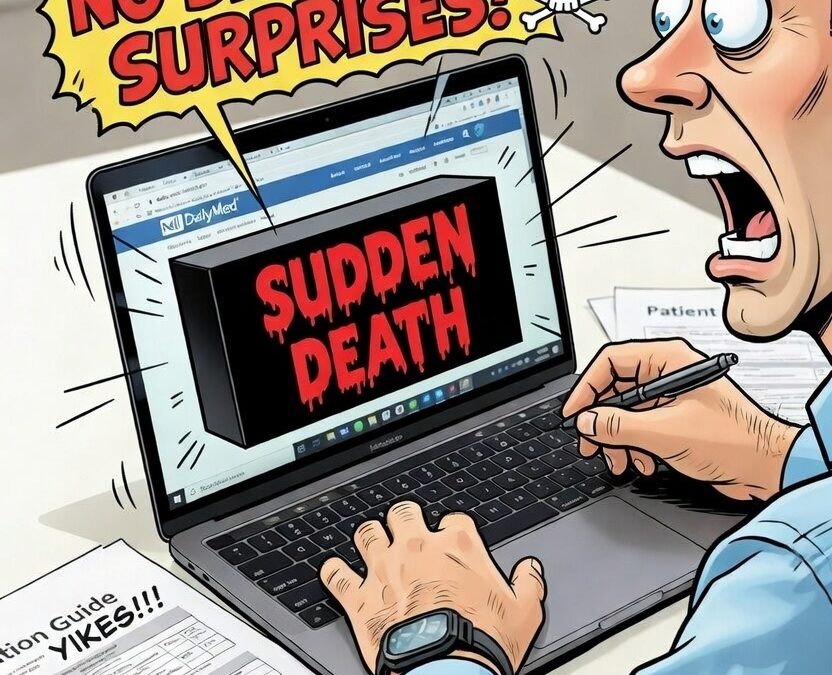
Recently, when I looked up the drug on the NIH DailyMed page, the black box warning hit me hard: I could easily have died from that infusion
WARNING: FATAL INFUSION-RELATED REACTIONS. – Administration of rituximab products can result in serious, including fatal, infusion-related reactions. Deaths within 24 hours of rituximab infusion have occurred. Approximately 80% of fatal infusion-related reactions occurred in association with the first infusion. Monitor patients closely. Discontinue RUXIENCE infusion for severe reactions…
Section 5.1 goes on to detail: Reactions include urticaria, hypotension, angioedema, hypoxia, bronchospasm, pulmonary issues, shock, anaphylaxis, or death—often in the first 30–120 minutes. Premedicate with antihistamine, acetaminophen; for some indications, steroids like methylprednisolone. Manage with epinephrine, oxygen, etc. Reduce rate or stop if severe.
They give multiple drugs just to safely administer this one. And for my case? Zero evidence it helped my variation of PCNSL.
The hospital charged high amounts for these drugs: On December 7, 2023, the rituximab-pvvr (RUXIENCE) injections totaled $11,455. Two weeks later, on December 21, the biosimilar rituximab-abbs rose to $14,063—a roughly 23% increase. Strange how the “cheaper” biosimilar option wasn’t cheaper. Biosimilars are marketed as cost-savers through competition, but in practice (with hospital markups, list prices, or other factors), they don’t always deliver the expected savings to patients or systems—especially in off-label use.
The Clinical Studies Behind the Approval
The DailyMed label for RUXIENCE cites studies from the original Rituxan (not new ones for the biosimilar). These are from Genentech/Roche and Biogen (original developers/marketers), often with academic/cooperative groups (e.g., ECOG, German study groups).
They focus on:
- Relapsed/refractory low-grade/follicular NHL (single-agent rituximab).
- Adding rituximab to chemo (CVP or CHOP) for untreated follicular or diffuse large B-cell NHL.
- CLL with fludarabine/cyclophosphamide.
No large trials for PCNSL appear in the—efficacy data bridges from those original pharma-sponsored studies showing benefits like better response rates and survival in systemic NHL/CLL.
Pfizer (RUXIENCE maker) did smaller biosimilarity trials to prove it’s similar to Rituxan, but the core approval relies on Roche/Biogen’s foundational work. (Truxima/rituximab-abbs has its own separate label, but draws from similar foundational data.)
Profit Ties: Roche/Biogen profit from branded Rituxan (billions historically). Pfizer (and others like Teva for Truxima) profit from biosimilar versions, capturing market share. The original positive data drives sales for all—yet as my billing showed, promised price competition doesn’t always materialize in real-world charges.
Why Transparency Matters
You deserve to know: Is this approved for my exact cancer? Is this product going to help me? What are the real risks? How does it work? Searching DailyMed yourself reveals a lot.
My severe reaction matched the black box warning—validating my experience. Asking questions empowered me.
The Key Resource: NIH’s DailyMed Database
This free tool from the National Library of Medicine is a game-changer for patient advocacy. It gives you the official FDA-approved drug labeling—straight from the source, reformatted for easier reading.
Here’s how to use it step by step to dig into any prescribed medication:
- Find the Exact Drug Name: Check the drug’s label or your medical billing statement (it’s often buried in the detailed codes—mine came from Mayo Clinic). Use the precise name, like “rituximab-pvvr (RUXIENCE)” or the NDC code if you have it, for the best match.
- Search DailyMed: Go to the NIH DailyMed Database and enter the drug name (or NDC/active ingredient). Locate your specific medication/version.
- Review Key Sections Yourself First:
- Indications and Usage: Compare approved uses vs. your condition—is it on-label or off-label?
- Warnings and Precautions: Look for black box warnings, serious risks, and infusion reactions (like mine).
- Clinical Studies: Examine the trials behind approval. Note:
- Do they include a placebo, or are they just comparing against similar drugs?
- What’s the study size? (Rare disease trials are often small, limiting reliability.)
- What are the trade-offs? (e.g., Is it worth long-term side effects for just 2 extra months of survival?)
- What are the long-term side effects?
- Take It Further with AI: Once you’ve found the right page, copy the full URL from your browser (it will look something like https://dailymed.nlm.nih.gov/dailymed/drugInfo.cfm?setid=…). Paste that exact link into an AI platform (like Grok, ChatGPT, or similar). Then ask your specific questions about that medication. This keeps the AI focused on the official details and helps you unpack complex sections—like interpreting study results, risks, or why certain data might not apply to your case.
Conclusion
Knowledge reduces fear and builds better decisions. Explore these tools, ask questions, share experiences (here or in communities). Wishing strength to everyone navigating this—may you find your path to wholeness too.